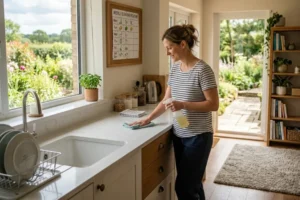

Decluttering sounds simple until you are standing in front of an overflowing wardrobe, a crowded kitchen drawer, or a spare room filled with things you have been “meaning to sort out” for years.
The problem is rarely a lack of motivation. It is usually the size of the task. When every room seems to need attention, deciding where to begin can feel exhausting. You may open one cupboard, find several difficult decisions, and give up before making visible progress.
Learning how to declutter your home without feeling overwhelmed requires a slower, more realistic approach. You do not need to empty the entire house, become a minimalist, or throw away everything that does not look perfect.
The goal is to make your home easier to use. By starting with a small area, setting clear limits, and dealing with unwanted items promptly, you can create more space without turning decluttering into an exhausting weekend project.
1. Start With a Small, Visible Area
Do not begin with the most emotionally difficult room. Start somewhere small enough to finish in one session.
A bathroom shelf, bedside table, kitchen counter, or single drawer can be a good first project. Completing one visible area gives you an immediate result and builds momentum for the next task.
The Greater Good Science Center recommends choosing a starting point that will have a noticeable impact while remaining manageable. Beginning too broadly can lead to decision paralysis or distraction.
Set a timer for 10 to 20 minutes and stop when it rings. You can continue when you have the energy, but you do not need to finish an entire room to count the session as successful.
2. Decide What You Want the Space to Do
Before sorting objects, decide how you want the area to function.
A dining table may need to support family meals rather than become permanent storage for paperwork. A bedroom chair may need to provide seating instead of holding a week’s worth of clothes.
This step gives you a practical reason for removing items. You are not getting rid of things simply because a decluttering rule told you to. You are creating space for an activity that matters.
Ask yourself three questions: What is this area for? What belongs here? What regularly gets in the way?
Once the purpose is clear, decisions become easier. A collection of unopened letters may belong in a small document tray, while old shopping bags and broken chargers probably do not need to remain on the table.
3. Use a Simple Sorting System
Complicated systems can create more work than the clutter itself. Use four basic categories: keep, move, donate or sell, and discard or recycle.
Keep
Keep items that are useful, meaningful, or regularly enjoyed. You do not need to justify every possession with a dramatic story.
Move
Some objects are not clutter; they are simply in the wrong room. Place them in a basket and return them to their proper locations after finishing the current area.
Donate or Sell
Items in good condition may be useful to someone else. The EPA recommends selling or donating unwanted clothes, appliances, furniture, tools, books, and working electronics instead of automatically discarding them.
Discard or Recycle
Broken, expired, unsafe, or unusable objects should leave the home responsibly. Check local recycling rules because accepted materials vary between areas.
Avoid creating a large “maybe” category. If you need one, limit it to a single box and add a review date. Anything untouched by that date can be reconsidered.
4. Make Decisions With Practical Questions
Sentimental questions such as “Does this bring me joy?” can be helpful, but they do not work for every object. Your tax documents, screwdriver, and spare light bulbs may be useful without creating happiness.
Use practical questions instead. Have you used the item recently? Would you buy it again today? Do you own another object that performs the same job? Is keeping it worth the space it occupies?
For clothing, ask whether it fits, feels comfortable, and works with your current lifestyle. Do not keep ten uncomfortable shirts because they were expensive several years ago.
For kitchen items, consider how many people live in the home and how often you entertain. A household of two may not need thirty mugs unless collecting them is an intentional hobby.
Do not spend ten minutes deciding about one inexpensive object. When the decision feels unusually difficult, set it aside and continue with easier items. Progress matters more than forcing every decision immediately.
5. Remove Unwanted Items Quickly
Decluttering is not complete when donation bags remain in the hallway for three months.
Choose a deadline for removing unwanted items. Put donations in your car, schedule a collection, or take them to an appropriate organisation within a few days.
Check what local charities actually accept before arriving. Donate items that are clean, usable, and in reasonable condition rather than treating a charity shop as a rubbish service.
Selling can be worthwhile for valuable products, but it also requires photographs, listings, messages, and delivery arrangements. Give yourself a time limit. If an item has not sold within a few weeks, reduce the price, donate it, or choose another practical option.
Personal documents need extra care. The Federal Trade Commission recommends securely storing important records and shredding documents containing sensitive personal information when they no longer need to be kept.
6. Dispose of Hazardous Items Safely
Not everything can be placed in an ordinary rubbish bin.
Paint, pesticides, oils, batteries, strong cleaning products, and certain automotive materials may contain hazardous ingredients. The EPA advises using special care when storing or disposing of these products and checking local collection programmes.
Do not pour unwanted chemicals down a drain, onto the ground, or into a storm sewer. Keep products in their original containers whenever possible and follow the instructions on the label.
Expired medicines, electronics, rechargeable batteries, and fluorescent bulbs may also require specific collection points depending on local regulations. Search the website of your local authority or waste service before disposing of unfamiliar items.
Responsible disposal may take longer than filling a bin, but it protects people, plumbing systems, and the environment.
7. Handle Sentimental Items Separately
Photographs, letters, gifts, inherited objects, and children’s artwork can slow down an otherwise simple decluttering session.
Do not begin with sentimental belongings. Build confidence by working through easier categories first, such as expired toiletries, duplicate kitchen tools, or clothes you never wear.
When you are ready, set a physical limit. You might keep one memory box, one shelf, or a defined number of photographs from a particular period.
Taking a picture of an object can preserve the memory without requiring you to store the item forever. You can also choose one representative piece from a larger collection.
Remember that releasing an object does not erase the person, event, or experience connected to it. Still, there is no need to rush emotionally difficult decisions simply to meet an artificial deadline.
8. Prevent Clutter From Returning
A successful decluttering project needs a maintenance plan.
Give frequently used items a clear and convenient home. Objects are more likely to be put away when the storage location is close to where they are used.
Try a five- or ten-minute evening reset. Clear one surface, return misplaced items, and deal with incoming paperwork before it becomes a large pile.
Be more selective about what enters the home. Before buying something, ask where it will be stored and what purpose it will serve.
Repairing, borrowing, renting, or buying second-hand can sometimes be more practical than purchasing another new item. The EPA recommends maintaining and repairing possessions so they do not need to be discarded and replaced as frequently.
You can also use a simple “one in, one considered” rule. When a new item enters a crowded category, review whether an older item still deserves its place.
9. Know When Decluttering Requires Extra Support
Ordinary household clutter is not the same as hoarding disorder.
Professional support may be helpful when someone experiences extreme difficulty discarding possessions, rooms can no longer be used for their intended purpose, or the clutter creates serious safety and hygiene problems.
The NHS identifies hoarding disorder as a mental health condition and notes that treatment may involve talking therapy, particularly cognitive behavioural therapy.
In that situation, a sudden forced clear-out may cause significant distress and may not address the underlying problem. Support should be respectful, patient, and guided by appropriate professionals.
Seeking help is not a sign of laziness or failure. It can be a practical step toward making the home safer and daily life more manageable.
Decluttering your home does not have to happen in one dramatic session. Start with one small, visible area and decide what you want that space to do. Sort items into simple categories, use practical questions, and avoid getting stuck on the hardest decisions first.
Remove donations and rubbish promptly, dispose of hazardous products safely, and treat sentimental objects with patience. Once the space feels better, create easy storage and short reset habits to prevent clutter from rebuilding.
Choose one drawer, shelf, or surface today and work on it for just 15 minutes. Finishing a small area will move you forward more effectively than spending another week waiting for enough time to organise the entire house.